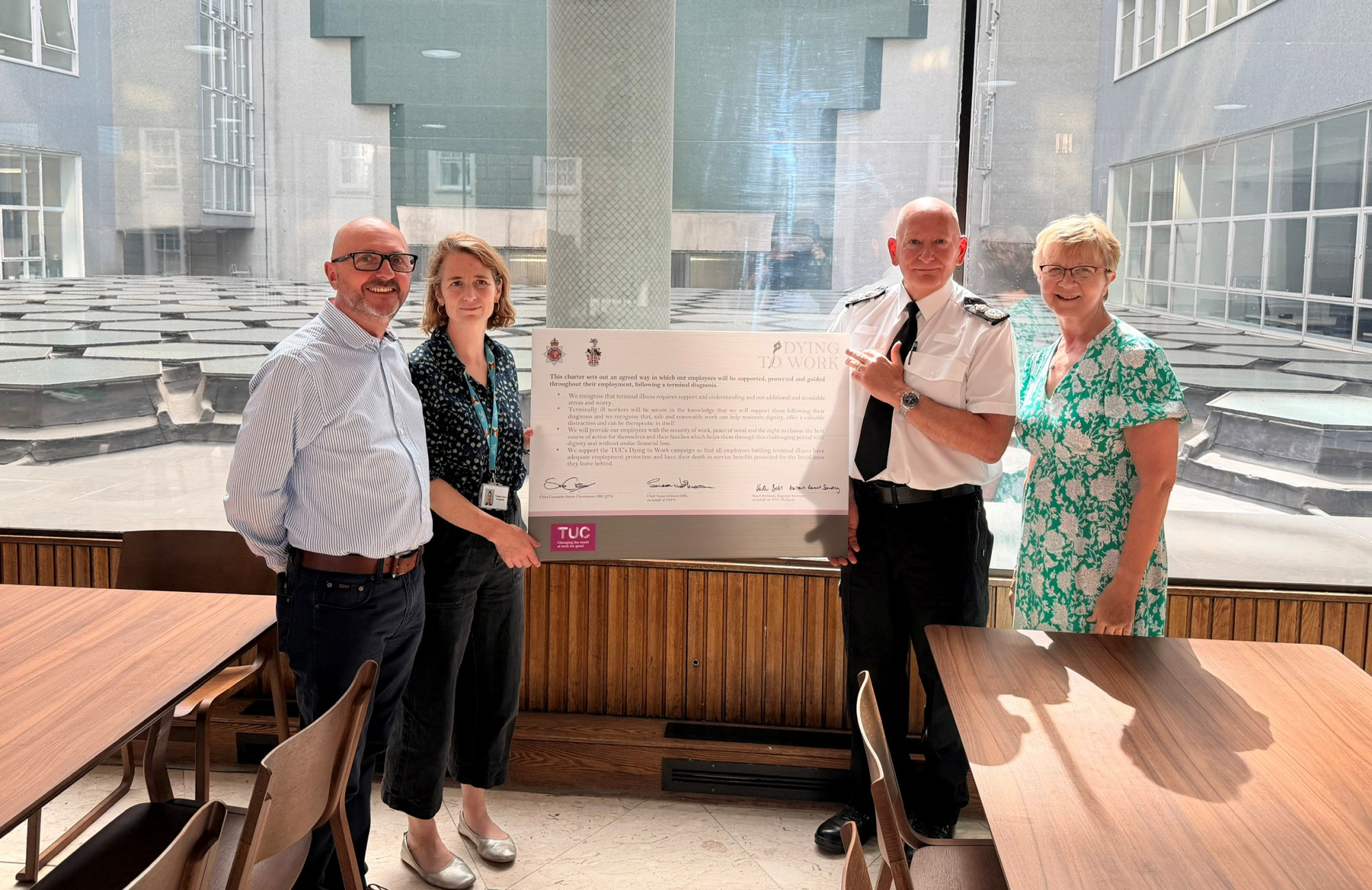
Civil Nuclear Police Federation has welcomed Civil Nuclear Constabulary's agreement to sign the Dying to Work Charter.
The voluntary charter aims to support employees who become terminally ill at work, and the Force is the latest employer to sign up. British Transport Police and the Scottish Fire and Rescue Service are amongst those who have recently adopted it.
The Charter is part of the TUC's wider Dying to Work campaign, which is seeking greater security for terminally ill workers where they cannot be dismissed as a result of their condition. It follows the case of Jacci Woodcook, an area sales manager from Derbyshire who was forced out of her job after being diagnosed with terminal breast cancer. The TUC hopes to prevent cases like Jacci's happening in the future.
The Federation has been encouraging the CNC to formally commit to the charter, viewing it as an important step in ensuring officers and staff facing a terminal diagnosis are not left worrying about their job security on top of everything else.
Chair of the CNP Federation, Darren Adams, said: “The Civil Nuclear Constabulary has long supported its people with dignity and compassion. As a Federation, we have driven this forward to ensure that commitment is now formally recognised through the Dying to Work Charter; not as a change in direction, but as a clear statement of the values we already uphold and a standard for others to follow.”
Chief Constable, Simon Chesterman, said: “Signing up to Dying to Work demonstrates our commitment to being a fair and supportive employer who recognises the challenges that life can throw at people. Being part of this movement and signing the charter should provide reassurance to CNC employees that if they’re facing the worst, they can at least rest easy where their job is concerned.”
You can read more about the Dying to Work campaign here.
Pictured from left to right: Colin Longstaff (CNP Federation), Kate Bell (TUC), CC Simon Chesterman (CNC), Susan Johnson (CNPA)