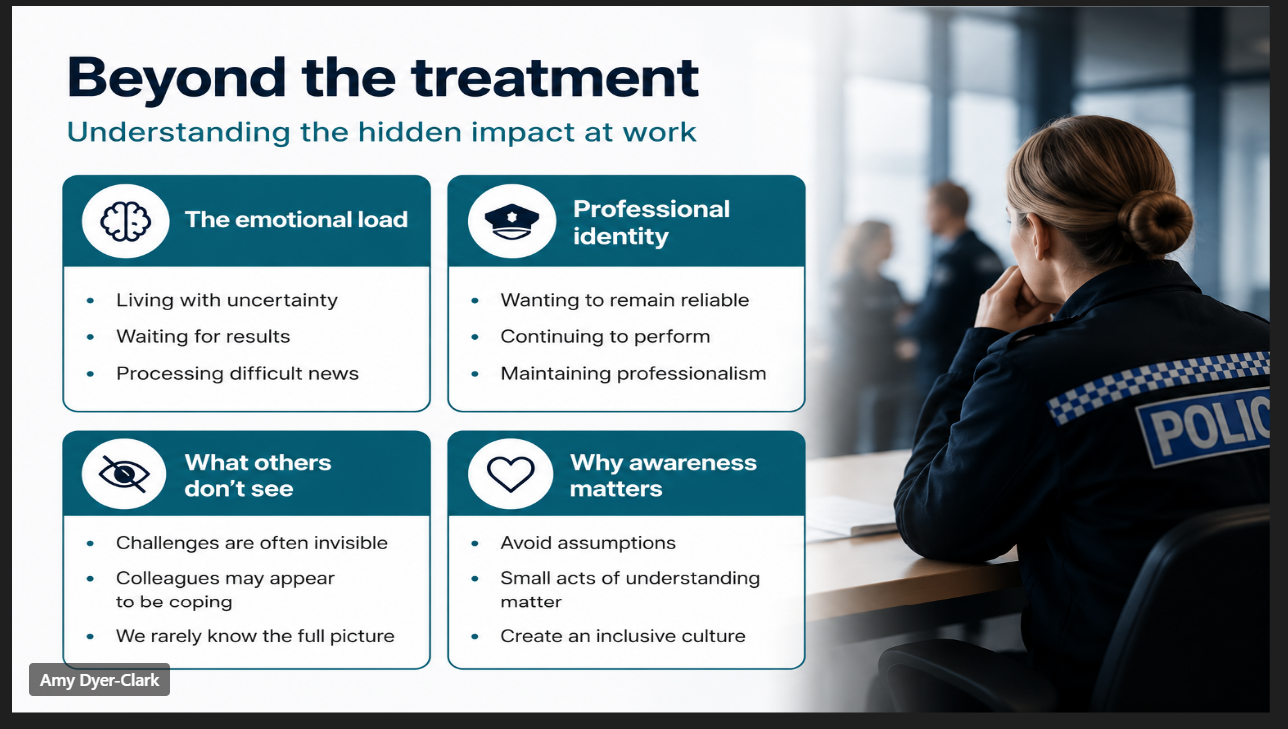
Many of us will work alongside a colleague going through fertility treatment without ever knowing it. That was T/Insp Amy Dyer-Clark's message during a recent Lunch and Learn session, which we joined alongside officers and staff from across the CNC and beyond.
Amy is a Force Incident Manager based at Culham HQ, with nearly nine years' service in the CNC. She currently serves as the Force Fertility Lead and has founded Blue Beginnings, a national peer support network for police officers and staff navigating fertility challenges while working in policing. Drawing on both her professional role and her personal journey, Amy led the session to help colleagues, and line managers in particular, feel more confident having supportive conversations about fertility.
The one-in-six stat
She opened with a surprising statistic: around one in six people of working age globally are affected by infertility. Not one in six women, but one in six people. Fertility is still too often seen as a "women's issue", yet male infertility accounts for roughly half of all cases, and partners, families and loved ones are affected too. Amy told us that almost 70% of people undergoing fertility treatment report taking sickness absence during that time, although the reality is that many use annual leave or work around appointments rather than disclosing what they're going through.
Amy walked us through what a typical IVF cycle can involve. A single cycle can mean between eight and fifteen medical appointments, none of which can reliably be planned weeks in advance. That can be a challenge when you work in an organisation that plans shifts, training, and deployments well in advance.
She also touched on miscarriage and baby loss, secondary infertility, and the different routes people take to parenthood, including donor conception, surrogacy, adoption, LGBT+ family building, and solo parenthood.
Supportive management
Much of the session focused on what supportive management looks like. Amy shared her own experience of waiting until her third IVF cycle before telling her line manager what she and her wife were going through, and how his willingness to listen and seek out the right advice made a difference.
Madi Sullivan from HR followed with a practical update on policy, including how pregnancy and maternity protections apply from the point of embryo transfer, and the work underway to improve time-off provisions for colleagues undergoing treatment. Chris Ella spoke about the forthcoming launch of a paternity buddies scheme and the Partners Matter support group.
Amy closed by signposting the wider Blue Families network of peer support groups, and the CNC's recent signing of the Fertility Workplace Pledge.
Our key takeaways
There were five important points we took from this Lunch and Learn session:
Fertility challenges affect far more people than we might realise. One in six people of working age are affected, including men, partners and people building their families in lots of different ways. This isn't only a "women's issue".
Unpredictable treatment plans can be difficult to manage at work. Appointments are often confirmed at short notice, and plans can change quickly. Early conversations can give managers the chance to plan ahead rather than react at the last moment.
You don't need to be an expert to support someone well. Thank someone for sharing their situation, ask how you can help them, and be honest if you don't know the answer (then go and find out).
Good intentions can still land badly. Amy shared comments such as “have you thought about adoption?" or "you just need to relax" which often come from a kind place, but they can minimise someone's experience. Colleagues don’t always need solutions, but they do want to be listened to.
A positive culture helps people to feel safe. Knowing a policy exists is one thing, but we need to be sure that when we ask for support, we will be treated with respect and not judged.
The Federation’s perspective
Kellan Denny, CNP Federation’s Lead for Female Representation and Menopause Support, opened the Lunch and Learn session. She explained: “As a Federation, we know how important it is to work closely with the Affinity Networks to fully support colleagues and promote what can be difficult but important conversations.”
“Fertility journeys can be a stressful time for anyone, never mind for someone in our role. We want to encourage officers to have these discussions with their line management to ensure that full support is in place for all going through this process. Although it’s a private matter, it shouldn’t be taboo.
“It is essential officers know that both the Federation and the Force recognise the strain, both emotional and physical, that fertility journeys can put on an officer and their families. Officers should know exactly what support the CNC can provide and what processes are in place to do so.”
Thank you to T/Insp Amy Dyer-Clark for such a personal and powerful talk, and to Madi Sullivan and Chris Ella for their contributions on the policy and support landscape. Following a short break over summer, the Lunch and Learn events will resume in September.